
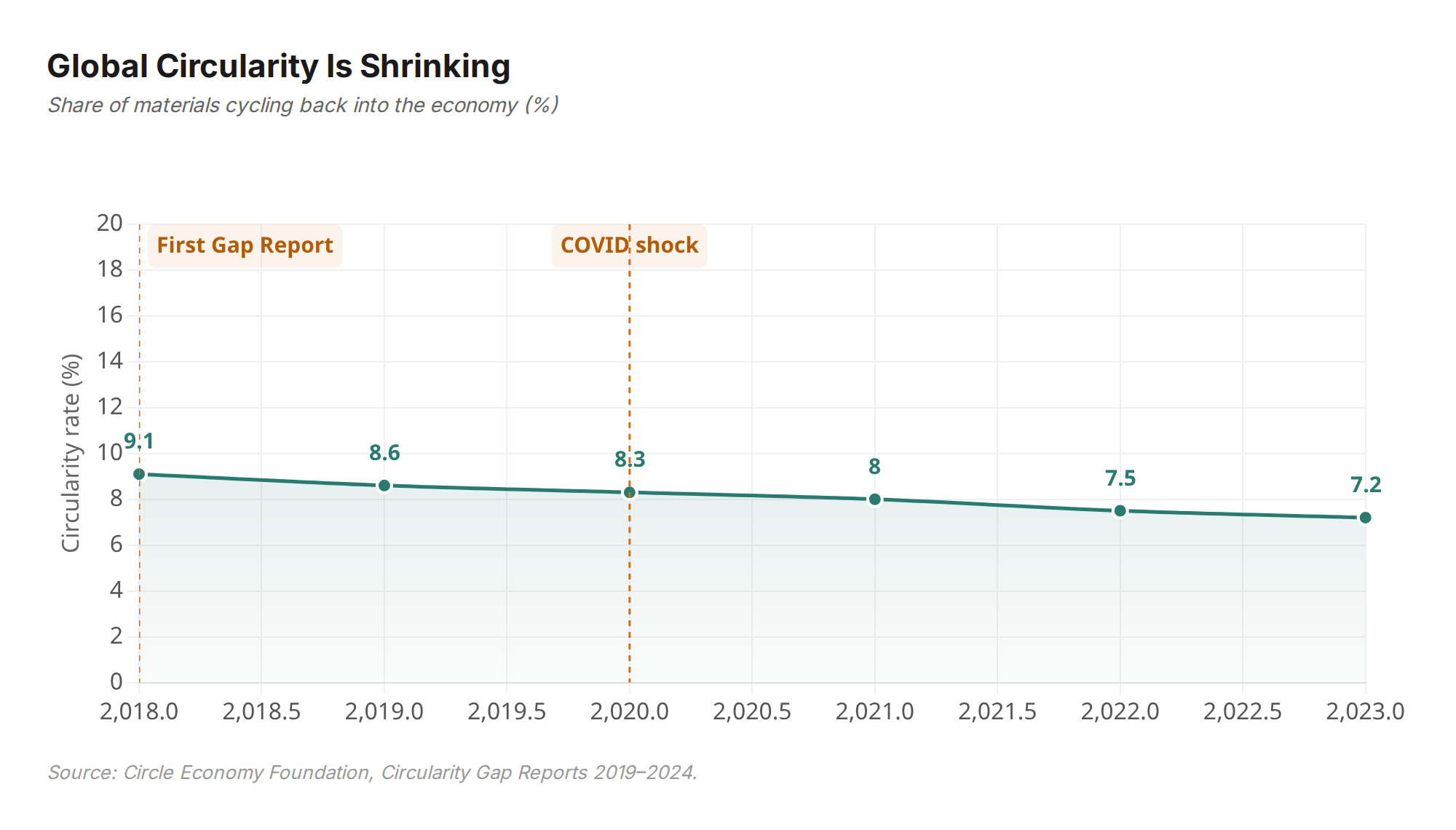
According to the Circle Economy Foundation's 2024 Circularity Gap Report, the share of materials cycling back into the global economy has dropped from 9.1% in 2018 to 7.2% in 2023. This decline happened during a period of unprecedented investment in circular economy programs, during an explosion of circular economy legislation, and while corporate circularity commitments filled sustainability reports across every major industry.
We are investing more in circularity and getting less of it, which is not a resource problem or a shortage of ambition but a thinking problem.
The circular economy, as most organizations and frameworks practice it today, treats material flows as an engineering puzzle solvable at the product level. Design for recyclability. Extend product lifetimes. Recover materials at end-of-life. These are sensible objectives. They are also radically insufficient, because they operate at the object level while the failures occur at the system level.
The distinction between these two levels of analysis matters, and confusing them has produced exactly the kind of apparent progress that the declining circularity gap numbers quietly document.
The Object-Level Trap
Consider a packaging company that achieves 95% recyclability across its product line. By every standard circular economy metric, this company is a leader. Its Circulytics score improves. Its sustainability report glows. Its investors applaud.
Now zoom out.
The same company increased total packaging volume by 20% over the same period. The recycling infrastructure in its key markets processes only 31% of what arrives. The virgin material required for its "recyclable" packaging costs less than recycled feedstock. And the consumers purchasing its products treat the recyclability label as permission to consume without guilt.
The packaging scores well on every circularity metric while the system it operates within expands material throughput, offshores waste, and accelerates consumption.
This is not a hypothetical edge case. This is the pattern. As Kirchherr, Reike, and Hekkert documented in their analysis of 114 circular economy definitions, the field converges on "reduce, reuse, recycle" hierarchies. These hierarchies operate almost exclusively at the product and material level. The Ellen MacArthur Foundation's butterfly diagram, the most widely adopted visualization of circular economy, maps technical and biological cycles of materials. It does not map the causal feedback loops, the emergent behaviors, or the power structures that determine whether those cycles actually close at scale.
The EU's Circular Economy Action Plan follows the same logic. Its targets focus on recycling rates, material recovery percentages, and digital product passports for specific product categories: packaging, textiles, electronics, construction. The 2024 Ecodesign for Sustainable Products Regulation extends lifecycle requirements further into product design. These are valuable regulatory developments. They are also, fundamentally, interventions at the object level.
Here is the structural problem: when we optimize objects within a system, we leave the system itself untouched. The dynamics that govern resource consumption, economic incentives, consumer behavior, and geopolitical material flows continue operating by their own logic. We improve the parts and wonder why the whole does not improve with them.
Anyone who has worked in complex systems recognizes this pattern. It is the difference between treating a symptom and treating a cause. We have built an entire global movement around treating symptoms.
When Systems Push Back
Complex systems do not sit quietly while we optimize their components. They push back. And when circular economy practitioners ignore system dynamics, they walk into traps that are well documented but consistently overlooked.
The rebound effect is real and measured. When circular strategies reduce costs or create secondary markets, they stimulate additional consumption. Studies on second-hand clothing markets reveal a striking dynamic: access to resale platforms acts as a moral license to buy more new product. The consumer who sells a jacket on a resale platform feels virtuous enough to buy two new ones. The net environmental benefit shrinks, sometimes to zero, sometimes below.
This is not a failure of individual behavior. This is a system dynamic. The rebound effect emerges from the interaction between pricing signals, consumer psychology, and market structures. No amount of product-level circularity design addresses it, because it does not live at the product level.
Burden shifting remains endemic. EU legislation prohibits shipping waste electrical and electronic equipment outside the continent. Yet containers full of electronics continue to arrive in Ghana and Nigeria under the label of "reuse." The object-level metric looks clean: the EU reports high collection and recycling rates for e-waste. The system-level reality is that waste flows to wherever governance is weakest. Circular metrics at the firm or national level mask what happens at the global level.
This is a classic system trap: optimizing a subsystem while degrading the larger system it operates within. National circularity metrics can improve while global material justice deteriorates.
The tragedy of the commons persists. Shared resources, from ocean plastics to atmospheric carbon to rare earth minerals, lack the governance structures that circular economy frameworks assume. Most CE tools presuppose that material flows operate within defined organizational or jurisdictional boundaries. In practice, the most critical material challenges involve commons that no single organization or jurisdiction controls. Rare earth minerals illustrate the point. Circular economy programs in Europe promote recovery and recycling of rare earths from electronics. But the extraction, processing, and geopolitical dynamics of these materials span continents, regulatory regimes, and power structures that no product passport captures.
Diminishing marginal returns set in. As recycling infrastructure matures, each additional percentage point of material recovery costs exponentially more energy, labor, and capital. A city that achieves 60% recycling can reach 70% with moderate investment. Reaching 90% requires a different order of expenditure entirely. At some point, the resource cost of recovery exceeds the resource value of the recovered material. Object-level optimization hits physical limits. System-level transformation faces no such ceiling, because it changes the conditions that generate waste in the first place.
These four dynamics share a common feature: they are invisible to tools that measure circularity at the product or material level. As Zocco and Malvezzi argue in their 2024 work on system dynamics modeling for circular economy, circularity has a "memory property." The history of a product's repair and reuse cycles matters, not just its current state. This is a systems insight. Most CE frameworks lack the modeling capacity to account for it.
At Except, we have seen these traps repeatedly across more than 700 projects spanning two decades of sustainability practice. We see organizations fall into them not because they lack ambition or competence, but because the tools they use do not show them the system they operate within. They are navigating by a map that shows the roads but not the terrain.
What Changes When You Zoom Out
So what happens when we apply systems thinking to the circular economy?
The first thing that changes is the definition of success. Object-level circularity measures closed loops: what percentage of material returns to productive use. System-level sustainability measures systemic health: does the system as a whole become more resilient, more equitable, more regenerative?
These are different questions with different answers.
A product that is 100% recyclable contributes to systemic health only under specific conditions. The recycling system needs renewable energy. The labor involved needs fair compensation. The secondary material market cannot undercut the economics of waste reduction. And the availability of recycling cannot accelerate consumption. Strip away any of those conditions and the circular product becomes a feel-good metric disconnected from actual sustainability outcomes.
The second thing that changes is where we intervene. Object-level CE focuses on product design, material selection, and end-of-life recovery. These are important levers. They are not the most powerful ones.
Systems thinking reveals leverage points that object-level analysis cannot see. Ownership models that decouple revenue from material throughput. Governance structures that internalize the cost of commons degradation. Information systems that make system dynamics visible to decision-makers. Economic incentives that reward systemic health rather than component optimization.
Consider ownership. The shift from product-as-a-service to access-based models changes the material incentive: the provider now benefits from durability. It changes the information flow: the provider now tracks usage patterns across the full lifecycle. And it changes the power structure: the provider retains responsibility that disposal-based models externalize to the consumer. This is a system-level intervention. It changes the dynamics, not just the materials.
Or consider how a global supply chain responds to circularity targets. When we worked with IKEA on their catalogue supply chain, the approach was not to optimize individual paper products for recyclability. The approach was to map the entire system: supplier networks, energy sources, water consumption, logistics, and the feedback loops between them. The result was a 28% reduction in CO2 emissions per catalogue copy over two years, a 35% decrease in water consumption, and a 30% increase in renewable energy use. Those numbers came not from making a more circular catalogue, but from understanding the system that produced it and finding the leverage points within it.
Object-level thinking asks: how do we make this product more circular? Systems thinking asks: how do we make the system that produces, distributes, uses, and recovers this product more sustainable? The second question subsumes the first and reveals interventions the first never considers.

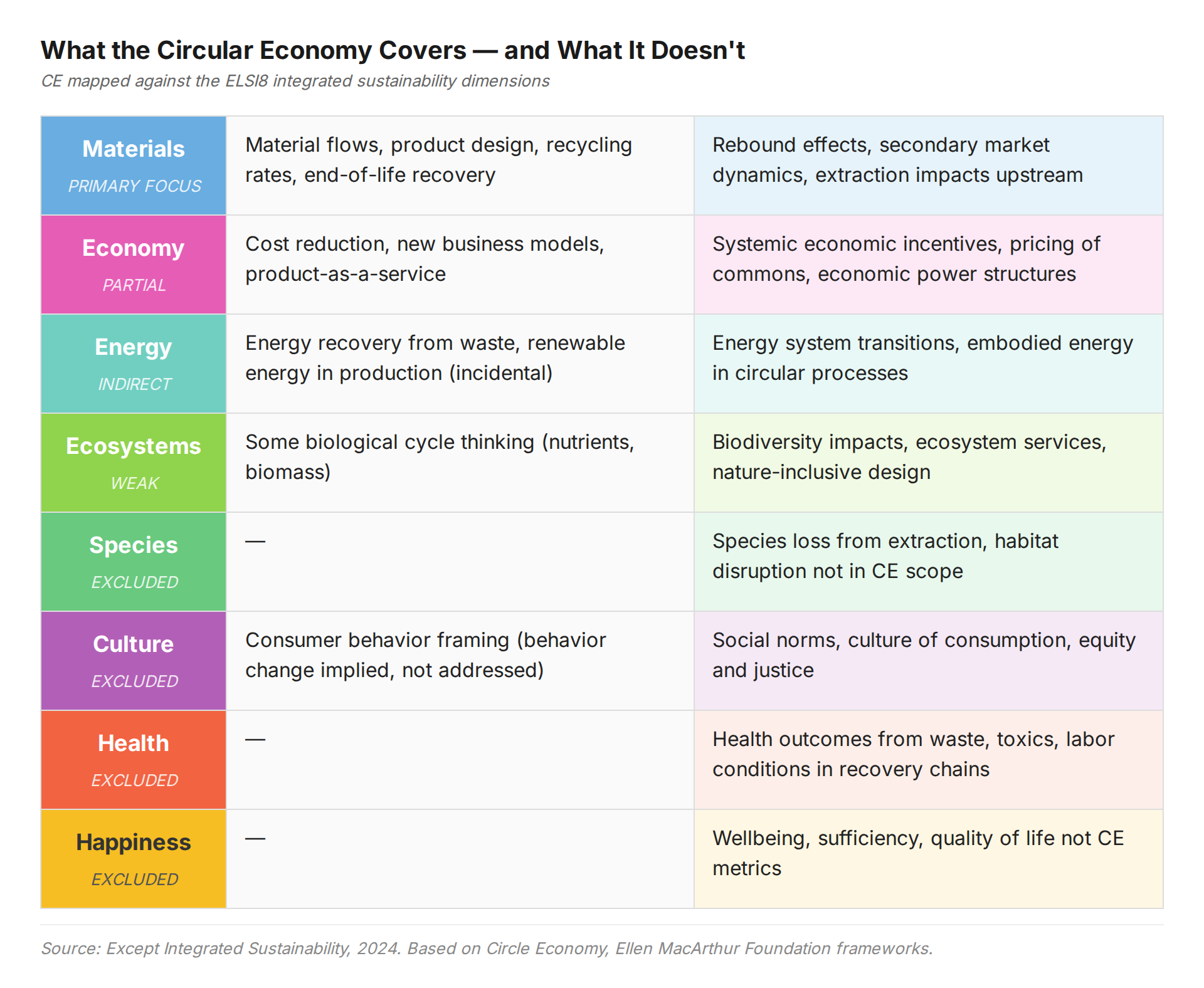
The third thing that changes is scope. The circular economy, as currently practiced, does not inherently address social justice, biodiversity, societal resilience, or nature-inclusive development. Following the majority of CE tools and projects to full implementation does not necessarily produce a just and resilient society. It does not even necessarily improve network-level societal parameters such as redundancy, flexibility, and stability.
This is not a semantic point; it is the structural gap that explains why circularity metrics can improve while systemic sustainability deteriorates.
Circularity is a necessary component of sustainability. It addresses an essential dimension: the material throughput of human economic activity. But it is one dimension among many. Treating it as a synonym for sustainability, as an increasing number of practitioners and policymakers do, narrows the aperture precisely when we need to widen it.
At a recent book launch on "Lessons on Circularity," the introduction stated: "It used to be called sustainability, and now it is called circularity." This encapsulates the problem. When a subset replaces the whole, the aspects it excludes disappear from the conversation. Social equity vanishes. Biodiversity drops off the agenda. Governance reform gets deferred. And the movement that set out to transform the economy ends up reinforcing the same reductionist thinking that created the problem.
As Saidani, Yannou, Leroy, Cluzel, and Kim document in their bibliometric analysis, circular economy and industrial ecology concepts are increasingly intertwined. Yet CE literature remains more practice-oriented while industrial ecology retains stronger theoretical grounding in systems analysis. The integration is incomplete. CE borrowed the actionable frameworks but left behind the systems theory that makes those frameworks meaningful.
Circularity Is Not the Enemy
Let us be clear about what this argument is and is not.
This is not an argument against circularity. The circular economy represents a worthwhile goal. Closing material loops, extending product lifetimes, designing for reuse, these are necessary interventions in a world that consumes resources at nearly twice the rate the planet regenerates them.
The argument is against reductionism. Against treating a subset as a substitute. Against measuring the circularity of objects while ignoring the dynamics of systems.
The Ellen MacArthur Foundation's work has been indispensable in making circularity actionable. The EU's regulatory frameworks are moving the right direction. Corporate circularity programs are generating real improvements at the product level. We cannot use these tools in a vacuum. Since these tools tend to focus on the object material plane, system dynamics fall outside their scope. The rebound effect, burden shifting, the tragedy of the commons, and diminishing marginal returns are real and present threats to projects that operate without systemic context.
The circular economy becomes genuinely transformative when it stops being the destination and starts being one instrument within integrated sustainability. When circularity programs include system dynamics modeling. When recycling targets sit alongside social justice metrics. When material flow analysis connects to governance reform and economic restructuring. When we measure not just whether a material loops back, but whether the system as a whole moves toward resilience.
We need this shift now. The global circularity rate is not declining because we lack recycling technology or corporate ambition. It declines because we keep applying object-level solutions to a system-level challenge. We keep refining the parts while the whole deteriorates.
The question for practitioners, policymakers, and organizations investing in circular economy is straightforward: are you optimizing objects, or are you transforming systems? The answer determines whether your circularity program contributes to sustainability or merely creates the appearance of progress while the structural problems deepen.
The transition goes deeper than methodology. It requires rethinking how we regard ownership, how we regard resource rights, and how we structure the relationship between individual economic activity and collective well-being. The circular economy, pursued with systems thinking, becomes a gateway to these fundamental structural questions. Pursued without it, circular economy becomes another technocratic exercise that optimizes within the existing paradigm while the paradigm itself remains the problem.
The tools for systemic sustainability exist. The frameworks exist. The experience exists, drawn from decades of integrated practice across hundreds of projects. What we need is the willingness to use them, and the honesty to admit that object-level optimization, however satisfying to measure, is not enough.
The frameworks and practice for this kind of integrated work exist, built across decades of sustainability work spanning hundreds of projects. What has been missing is the honesty to treat circularity as one instrument within a larger system rather than as the goal itself.

Ngày 23 tháng 5 năm 2026
Further reading

knowledge
Circularity is not sustainability
For a sustainable future, we will need to adopt and develop circularity across every industry and sector. Not only will it …

knowledge
The Anatomy of a System
The term “sustainable” is now ubiquitous across society, yet its actual meaning is elusive and often misunderstood. For exa…

knowledge
The Rise of Systemic Investments
To realize a sustainable society, we need to address our bruised environmental and economic systems in their entirety. For …