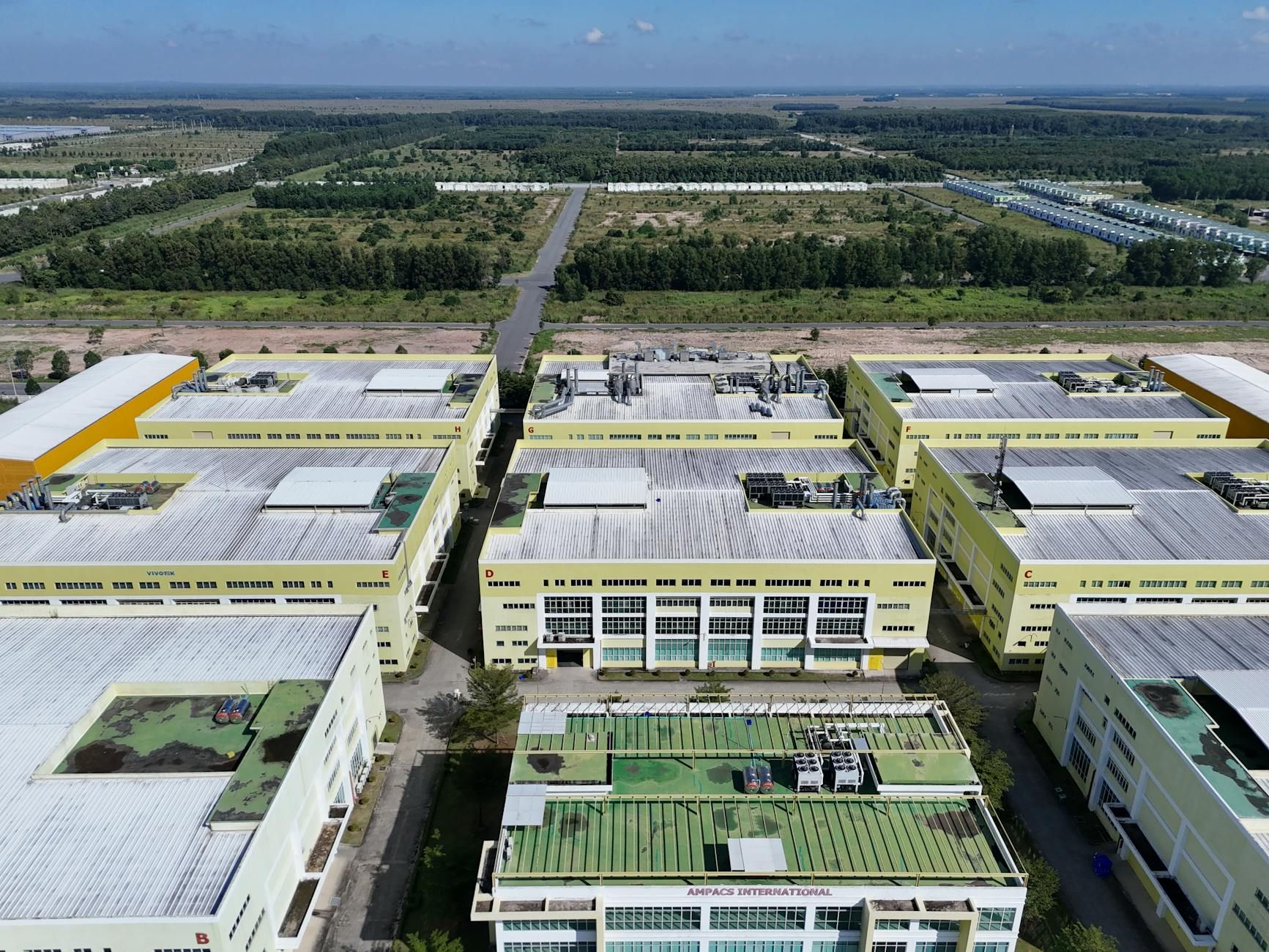

Here is what progress looks like in Binh Duong, Vietnam, in 2025. A 44,000-square-meter factory under construction, designed to LEED Gold standards, with 50,000 solar panels generating power from a rooftop the size of 70 football fields. One of many industrial parks flourishing in the fastest growing industrial production country in the world.
Now look at the same site from 500 meters up. The factory sits inside VSIP Binh Duong, one of 14 Vietnam Singapore Industrial Parks spread across the country. It is surrounded by manufacturers who share none of its energy systems, whose waste streams connect to nothing, whose material flows terminate at the loading dock and disappear into regional infrastructure. The zone hosts electronics assembly, consumer goods production, and logistics. Potential for synergy can be found everywhere, but as built, it is a collection of isolated objects, not a system.
Vietnam is in the middle of building 410 of them.
A lost opportunity from a price paid elsewhere
There are plenty of examples for what comes next. In the 1960s and 1970s, US, Britain, Germany, and Japan built industrial prosperity at enormous environmental cost. Rivers caught fire. Disease spiked near industrial areas. The economic model that worked also exported its damage into the air, water, and public health of surrounding communities. And it embedded the future of these communities in concrete.
The cost of the cleanup, when it came, has been staggering. Germany spent hundreds of billions of euros retrofitting industrial infrastructure. Japan's Minamata disease settlements, acid rain remediation, and industrial site cleanup ran into trillions of yen. The US Environmental Protection Agency's Superfund program has spent over $60 billion since 1980 cleaning contaminated industrial sites, with decades of pipeline still ahead. Every nation that industrialized on the old model spent the next 50 years paying to undo it.
Development economists have a name for this: the Environmental Kuznets Curve. Pollute first, clean up later, once you are wealthy enough to afford it. The economic reality of this is, as is obvious to observe, painful. For carbon dioxide, health impact, ecosystem services, and biodiversity loss, the record is devastating. And more importantly: even where countries eventually cleaned up, they did so using technology and institutional frameworks that did not exist when they first industrialized.
Vietnam does not need to walk down this same linear path.
Vietnam is industrializing now, which brings many good things to the country. But, accepting the linear path is not the price of development, it is a choice, and another choice can be made with similar benefits, and without the destruction.
410 zones following one design
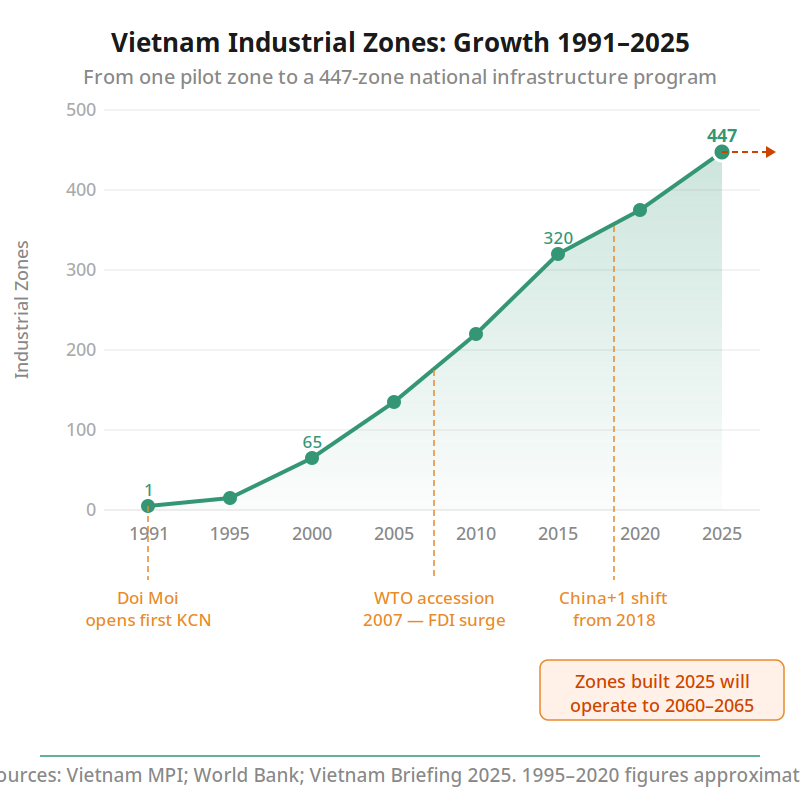
Vietnam's industrial zone program is extraordinary in scale. From the first KCN established in Tan Thuan in 1991, the country has expanded to approximately 410 operational zones by 2024. A further 100-plus are in planning or construction, driven by competitive labor costs, fast approvals, and the post-China+1 FDI wave. It is one of the most rapid industrial infrastructure deployments in Asia's recent history. In the world, even.
Each zone runs on essentially the same model: concentrated manufacturing clusters, shared road and utility infrastructure, central management. A handful have been designated eco-industrial parks, supported by UNIDO's global EIP program, with genuine results: water recycling up, energy efficiency improved, some industrial symbiosis connections established where one factory's waste becomes another's input.
And yet.
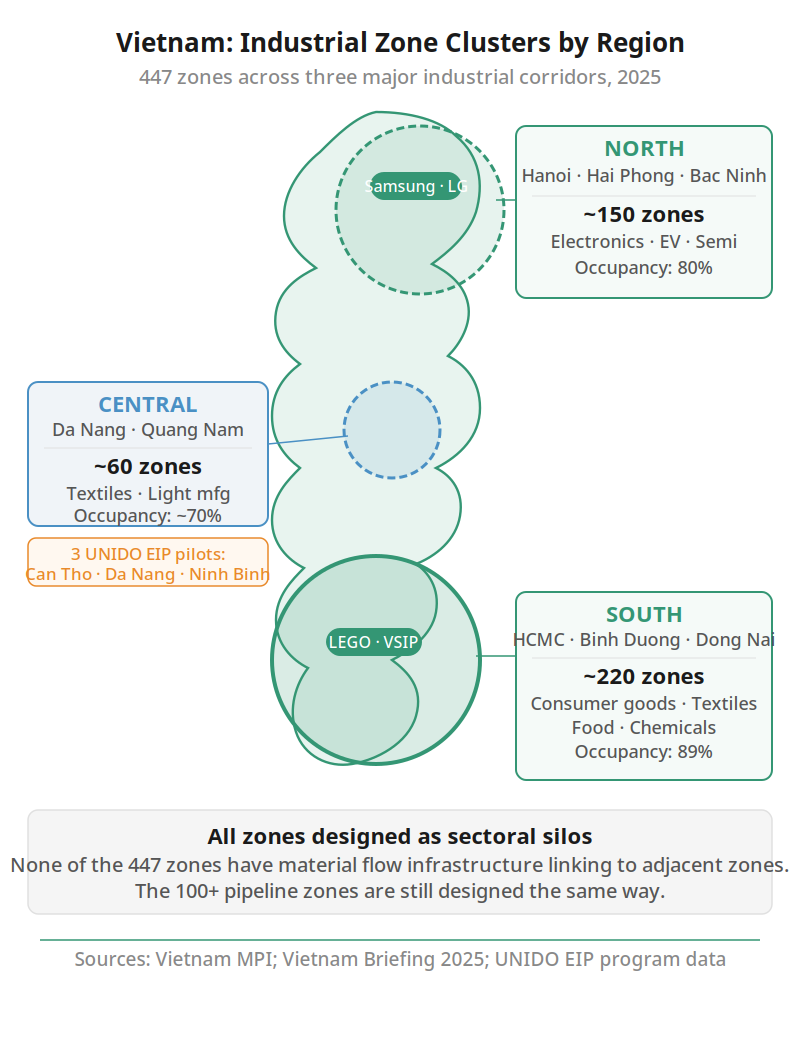
If you look at these zones not as collections of factories but as systems, ask what flows in, what flows out, and what the design makes possible or impossible? A different picture emerges. The zones are sectoral silos: electronics zones host electronics manufacturers, textile zones host textile manufacturers. This builds competitive clusters for FDI attraction, a logical development reason. From an industrial symbiosis standpoint however, it is exactly wrong.
An electronics zone produces electronic waste, heat, and specific chemicals. A textile zone produces fiber waste, water effluent, and heat. They could exchange. They almost never do, because they are not in the same zone, no infrastructure exists for exchange, and no policy framework makes it economically attractive.
LEGO's Binh Duong factory makes this visible at the object level. Its targets are serious: 100% renewable electricity, on-site wastewater treatment, zero waste to landfill. But the factory's thermal waste, production off-cuts, and packaging materials flow nowhere useful in the zone around it. They are managed as waste rather than designed as inputs. LEGO is doing what it can within the infrastructure it is given, but it can only do so much. The problem is the infrastructure around it.
Research by Le Thi Thanh Mai and colleagues published in 2025 found that Vietnam's CO2 emissions grew at 7.26% annually between 1986 and 2014, with trade openness and energy use as the primary drivers. As Vietnam's growth continues, emissions will continue rising as there's no infrastructural plan to prevent this. Vietnam's net-zero pledge has to fight against the structural incentives of the economic model being deployed.
What are the options?
In 1972, a network of companies in Kalundborg, Denmark began exchanging waste and by-products. An oil refinery shared excess gas with a power plant. The power plant shared waste heat with a fish farm and a pharmaceutical company. Gypsum from the power plant's scrubbers became wallboard. Fly ash became cement. Steam became district heating.
None of this was planned from above. It emerged from bilateral agreements between companies that discovered each other's waste streams were useful inputs. Over 50 years, the Kalundborg Industrial Symbiosis has involved 12 companies in more than 30 resource exchanges. It's reduced annual CO2 emissions by approximately 635,000 tonnes, cutting annual water consumption by 3 million cubic meters, and generating over $160 million in cumulative cost savings.
The business case adds up: every resource cycle closed reduces exposure to commodity price volatility, because inputs from within the system are more reliable than those from global markets.
The question for Vietnam is not whether industrial symbiosis works. That was answered in Denmark in 1989. The question is whether Vietnam's zone design makes symbiosis structurally possible.
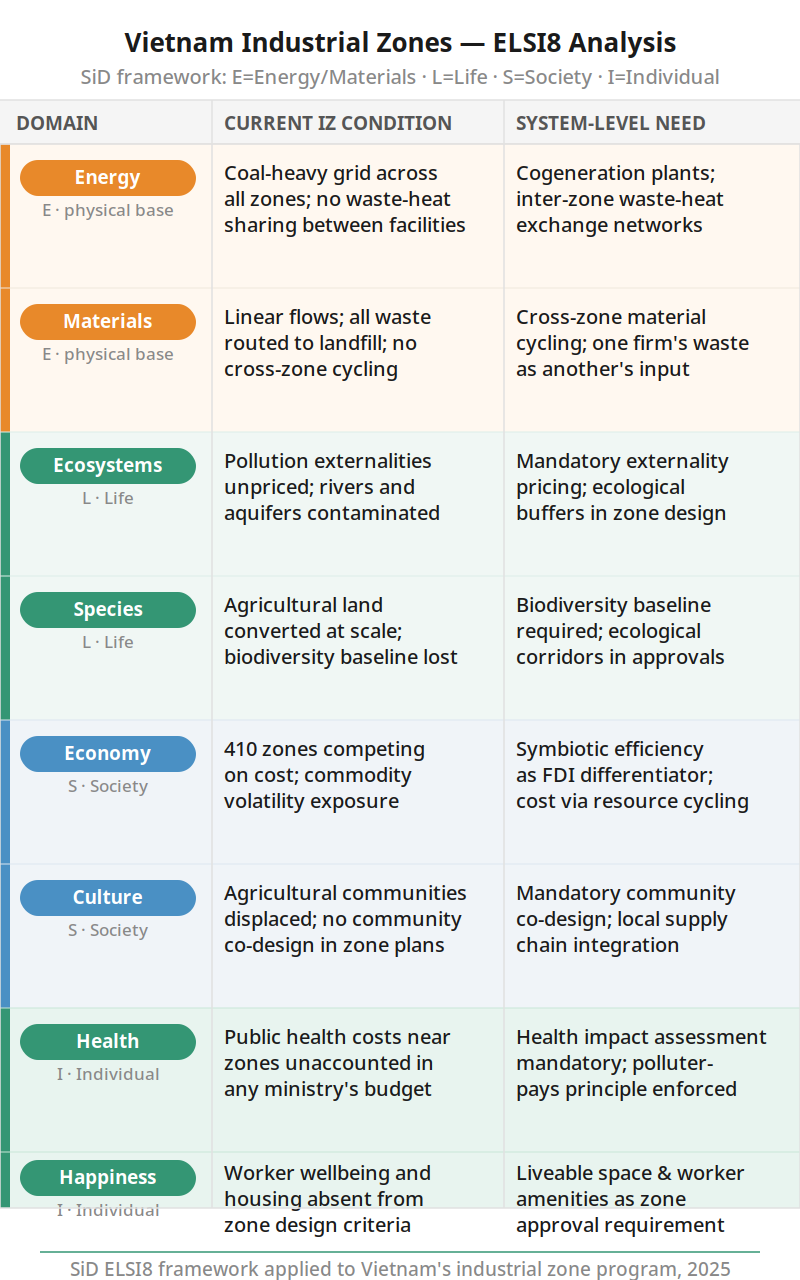
Currently, it mostly does not. Sectoral clusters prevent cross-industry exchange, which is a failure in regional planning. On site, resource exchange requires physical infrastructure; pipelines for steam, conveyor systems for material flows, shared storage for by-products. These are far cheaper to build at design stage than to retrofit afterward. New zones going up today will not have it, because the design criteria do not require it. And without a carbon price or a mandatory material disclosure system, industrial waste remains a cost to dispose of rather than a resource to exchange.
The UNIDO EIP program deserves credit as the most serious intervention in Vietnam's industrial zone landscape. It has converted three zones in Can Tho, Da Nang, and Ninh Binh to eco-industrial park status with real, evidence-based improvements. But it retrofits symbiotic connections into infrastructure not designed for them, and it does not change the design criteria for new zones, which continue to be approved on the same conventional template.
The Window
The economic case for building differently is not primarily environmental. It is competitive. Kalundborg participants documented $160 million in savings over five decades. Its supply chain resilience proved its value sharply during COVID-19. ESG-aligned FDI is growing fast, and premium brands are actively looking for industrial locations that support sustainability commitments, not just cost requirements.
A Vietnam industrial zone that can credibly offer industrial symbiosis infrastructure and documented emissions performance will attract a category of investment that conventional zones cannot. The 2030s FDI landscape will reward circular zones. Vietnam's current program is competing for the 2020s.
The infrastructure going up now has a 30-to-40-year useful life. The zones opening in 2025 will still be operating in 2060, five years past Vietnam's net-zero target. The people developing Vietnamese industrial policy are not indifferent to these arguments; I have worked with enough of them to know that. They are working within a system that selects for speed, FDI volume, and cost competitiveness, because those are the metrics by which success is measured. Changing those metrics is a governance challenge, not a technical one, and Vietnam has shown it can meet governance challenges when the political will is there: the COP26 commitment, the JETP agreement, and the EIP program are all evidence of that capacity.
The 100 zones still in the pipeline are the ones that matter now. There is still opportunity to design them with mixed-industry diversity from the start. To require resource exchange infrastructure before the first groundbreaking. To make the circular configuration the default rather than the premium option. These are the decisions that determine what Vietnam's industrial sector looks like in 2060.
The LEGO factory in Binh Duong could be the starting point for something more. Every kilowatt of waste heat, every production off-cut, every packaging stream that factory generates is a potential input to something else in the zone around it. Building that connection, between the object-level ambition LEGO has already demonstrated and the system-level infrastructure that makes it multiply, is the gap Vietnam has a chance to close right now, while the concrete is still wet.

15 May 2026
Further reading
knowledge
Eco-Industrial Parks and Industrial Symbiosis
The drive toward Eco-industrial parks and the support for a more sustainable future are gaining momentum with investors, bu…
knowledge
Why Circular Economy Fails Without Systems Thinking
According to the Circle Economy Foundation's 2024 Circularity Gap Report, the share of materials cycling back into the glob…

knowledge
Sustainability Strategy vs. ESG Strategy
Over the past decade, ESG has become a buzzword in the corporate world. Companies proudly release annual ESG reports, inves…
knowledge
Vietnam's Race to Net-Zero Carbon Emissions
Vietnam has outlined bold carbon reduction goals in its National Green Growth Strategy 2021-2030. With this, it has entered…