

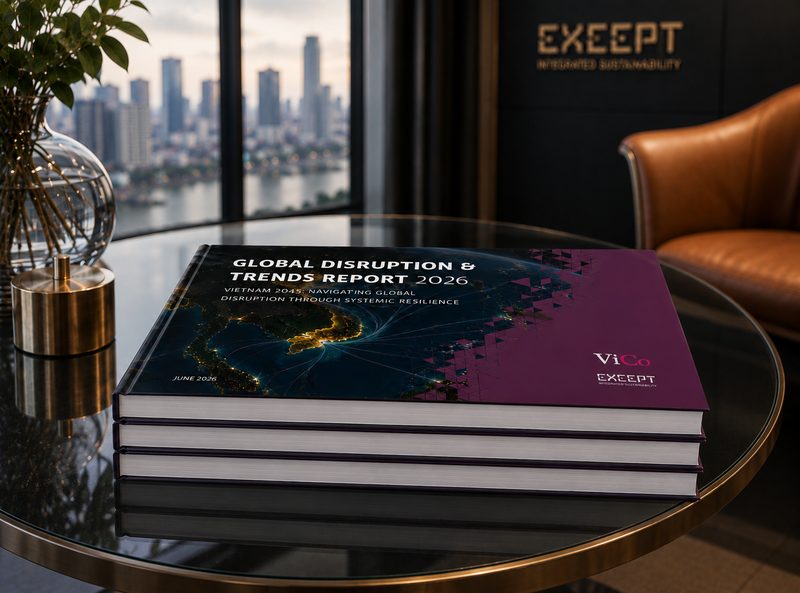
The Global Disruption & Trends Report 2026 maps 91 global trends against Vietnam's systemic resilience across 54 pages, identifying where strengths create leverage and where dependencies create risk. A freely available deep-insight report, download below.
Vietnam reduced poverty from 38% to 3.8%, grew GDP at 6-7% annually for three decades, and increased economic complexity by 800% since 2000. In 2024, VinFast outsold Toyota by 100,000 units. The country leads ASEAN in EV adoption at 36% and ranks second globally.
The same period produced a 429% increase in CO2 emissions (0.7 to 3.7 tonnes per capita), a drop in renewable energy share from 55% to 21%, trade exposure of 165% of GDP (four times Indonesia's), and 70% of the population living in flood-prone zones. The IMF and World Bank project the 2020s as the slowest growth decade since the 1960s. Global temperature exceedance of 1.5C is "very likely" this decade.
The Global Disruption & Trends Report 2026 maps these converging forces across 54 pages, identifying where Vietnam's strengths create leverage and where its dependencies create risk.
Deep insight from 91 global trends
Lead author Tom Bosschaert and co-author Tam Le conducted six months of research combining three approaches:
Data synthesis. The report draws on 25 institutional publications from the IMF, World Bank, OECD, Asian Development Bank, World Economic Forum, McKinsey Global Institute, Stanford HAI, UNEP, IEA, IRENA, and WHO. From these, the team identified and categorized 91 global trends: 42 negative, 21 positive, 28 mixed.
Systemic assessment. Using Except's Symbiosis in Development (SiD) framework (open-source since 1999), the report evaluates Vietnam across Resilience, Autonomy, and Harmony (RAH), tracking 24 KPIs across eight domains. Six regional peers provide comparative context: Thailand, Indonesia, Malaysia, Philippines, Singapore, and China.
Expert validation. Eight cross-sector practitioners tested and deepened the findings at a seminar on January 22, 2026, at Amanaki Hotel in Ho Chi Minh City.
The critical RAH Assessment
The SiD framework produces a three-dimensional profile of systemic health for Vietnam:
Harmony (strong, improving). Vietnam's social cohesion, cultural adaptability, and poverty reduction record demonstrate robust foundations. The shift from 38% poverty to 3.8% over three decades, combined with increasing economic complexity, reflects a society that distributes growth more broadly than many regional peers.
Resilience (moderate, mixed). Infrastructure investment is accelerating (Ho Chi Minh City's Metro Line 1 took 20 years; six new lines are now underway), but climate vulnerability remains acute. Seventy percent of the population lives in flood-prone areas. The energy transition requires an estimated USD 600 billion by 2050. Globally, clean energy investment already reaches USD 2.2 trillion annually, double fossil fuel investment.
Autonomy (weak, declining). Trade dependence at 165% of GDP creates exposure to supply chain disruption and geopolitical shifts. The energy balance flipped from 30% exporter to 37% net importer since 2000. AI adoption among businesses reached 78% in 2025, but the technology and platforms remain largely imported.
The 12 Vulnerabilities
The intersection of global trends and Vietnam's systemic profile reveals 12 specific vulnerabilities across trade, energy, demographics, climate, technology dependence, and institutional capacity. Each vulnerability maps to concrete indicators, not abstract risk categories.
The Demographic Window
Vietnam's old-age dependency ratio stands at 13.4%, compared to Thailand's 19% and China's 20%. This creates a 15-20 year window during which the working-age population remains large relative to dependents. The report frames this window as the defining constraint: every strategic priority, from energy transition to trade diversification to institutional reform, must deliver results within it.
The Seminar
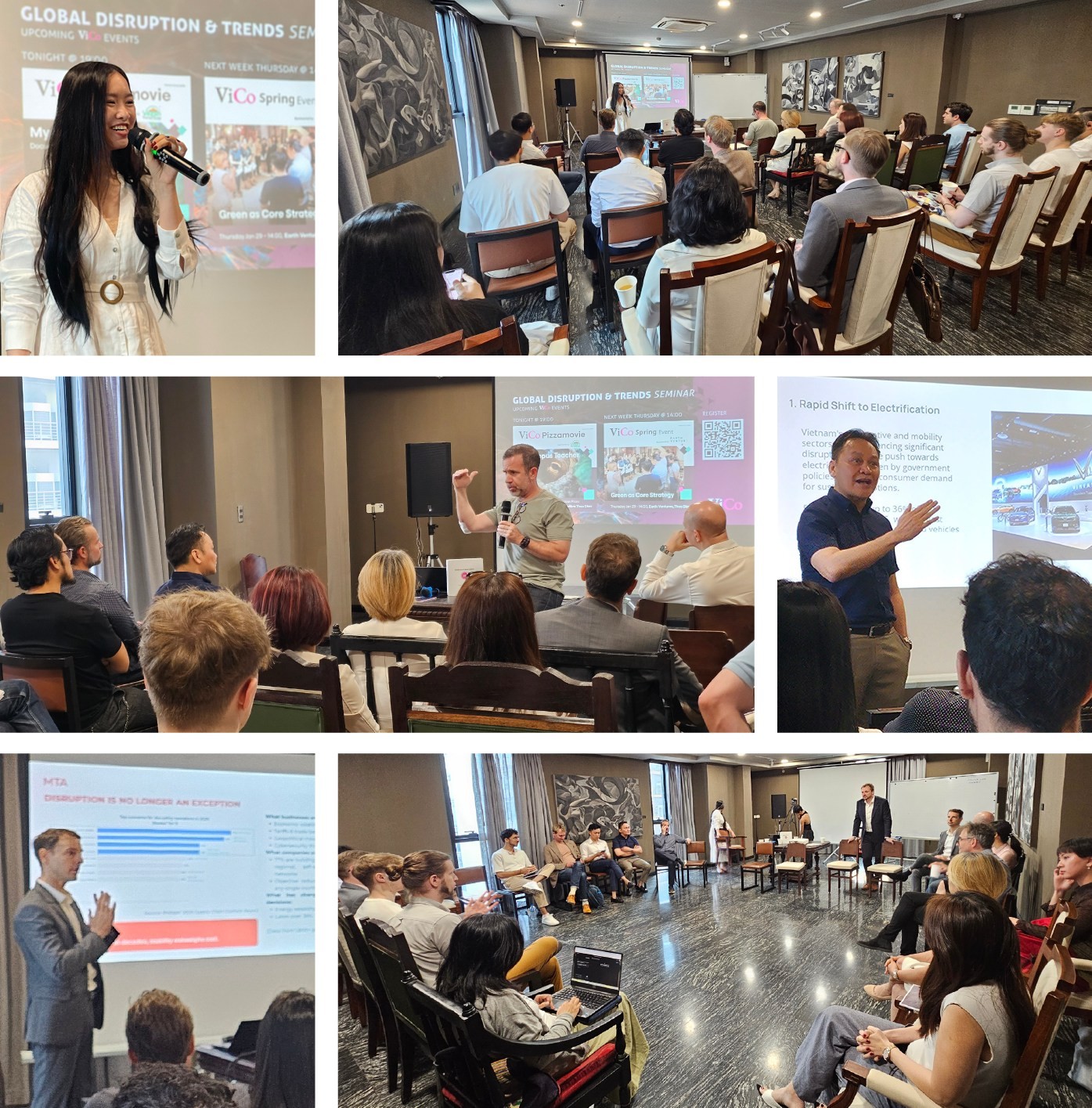
On January 22, 2026, from 1:30 to 5:00 PM at Amanaki Hotel in Thao Dien, HCMC, eight speakers brought the data into conversation with operational reality:
Tom Bosschaert (Except/ViCo): "The essential component of these transitions is not money, not space, not resources, not knowledge. It is cooperation."
Matthew McGarvey (Xylem Capital): "Never bet against Vietnam."
Paul Tonkes (Core5/Indochina Kajima): Vietnam as "the Switzerland of manufacturing" and "the Germany of the Global South."
Wolfgang Backer (DEKRA): "Whether Vietnam continues to compete on cost, or deliberately builds competitiveness around trust, quality, and sustainability capability."
Phuc Pham (VinaCrowd): Metro Line 1 took 20 years, six new lines now planned. Housing costs reach 20-21 times income.
Guillaume Rondan (MoveToAsia): "The last 10 years, one of the main reasons was costs. Now people are looking for something else."
Paul Nguyen (DealersEdge/MedEV): "The single best investment: people."
Willem Smit (Fulbright University Vietnam): "The Ice Hotel was born from melting ice, not from a business plan."
Event details: vico.asia/events/global-disruption
Contributors and Sponsors
Authors: Tom Bosschaert (Lead Author, Founder & Director, Except) and Tam Le (Co-Author, Except).
Team: Minh Nguyen (Relationship Management), Kano Nguyen (Event Coordination), Baro Nguyen (Design), Ruby Le (Design).
Sponsors: Except (research and publication), ViCo (community and convening), BoostGood (AI-assisted data analysis), Amanaki Hotel (venue).
The report is published under Creative Commons BY-NC-SA 4.0 and available for free download.
30 May 2026
Download the report (free)

Global Disruption & Trends Report '26: Vietnam 2045
Related Articles
knowledge
Vietnam Is Building the Last Industrial Revolution
Here is what progress looks like in Binh Duong, Vietnam, in 2025. A 44,000-square-meter factory under construction, designe…

project
Starprint Vietnam Sustainability Journey
Starprint Vietnam (SV), a key player in Vietnam's packaging industry, is spearheading a sustainability revolution. Partneri…
project
Pizza 4P’s Sustainability Strategy
What steps does a dedicated company take when it strives to deepen its sustainability efforts in the industry? This questio…